
How Fountains Reduce Perceived Urban Noise
Short answer: fountains don’t lower the decibel reading on a noise meter. They change what a listener notices, and that shift, from traffic and sirens to something closer to a stream, is what people mean when they say a plaza feels quieter.
That distinction matters if you’re specifying a water feature to solve an acoustic problem. A fountain doesn’t compete with road noise on volume and win. Acoustic research on urban soundscapes has consistently found that water sound and traffic noise overlap in only part of the frequency range, and in some conditions the traffic noise masks the fountain more than the other way around. The fountains that actually improve a space aren’t the loudest ones. They’re the ones designed with the acoustic environment in mind from the start, the same specification discipline covered in how much maintenance a fountain really requires.
Here’s what the research actually shows, and what it means for how you specify a water feature meant to do acoustic work.
What “Masking” Actually Means
Masking is often described as a decibel contest, as if a fountain simply needs to be louder than the traffic behind it. That’s not how the perception works. Multiple soundscape studies have found that the effectiveness of water sound depends on how closely its frequency content overlaps with the noise it’s meant to cover, not on raw volume. Broadband water sounds with strong low-frequency content mask road traffic more effectively than thin, high-pitched spray, because that’s where traffic noise sits.
This is why two fountains that look similar can perform completely differently in the field. A tall, narrow jet produces a different spectral signature than a wide cascade or a churning basin, and only some of those signatures actually sit where they need to for a given site’s noise profile.
Perceived Quiet Isn’t the Same as Measured Quiet
Field and laboratory studies on urban soundscapes have found that adding a pleasant water sound to a traffic-affected space improves how people rate the overall quality of that soundscape, even when the measured noise level barely changes. People aren’t evaluating decibels. They’re evaluating whether the space feels calm, and a well-chosen water sound shifts that judgment even in situations where it isn’t technically masking much of anything.
The inverse is also true, and it’s the part that gets missed most often in the design phase. Research on fountain acoustics has found that unpleasant water sounds, harsh splashing, or a waterfall-style crash that reads as chaotic can lower the perceived quality of a soundscape instead of improving it. A poorly chosen water feature doesn’t just fail to help. It can make a space feel louder and more agitated than it did before the fountain went in.
That means the acoustic outcome of a fountain isn’t a given. It’s a design decision with a wrong answer built in, and getting it wrong is easy if sound isn’t part of the specification conversation.
What Determines Whether a Fountain Quiets a Space
Flow rate and jet type. Higher flow rates generate broader, richer sound, but they can also tip into the kind of harsh, waterfall-like acoustic that studies associate with lower pleasantness ratings. The goal is a full, low-frequency-rich sound without crossing into something that reads as chaotic or crashing.
Distance and placement relative to the noise source. A fountain works best when it sits between the listener and the noise, close enough that its sound reaches the ear before the traffic does. Placement decided purely on sightlines, without accounting for where the noise is coming from, wastes most of the acoustic benefit.
Site acoustics and reflective surfaces. Hardscape, walls, and adjacent buildings can either reinforce or scatter a fountain’s sound. A feature that would work well in an open plaza can underperform in a tighter courtyard with different reflective conditions, or vice versa.
Consistency of the sound. Studies on soundscape pleasantness point to steady, continuous water sound as more effective and more pleasant over time than an irregular, on-and-off cycle. A controller that cycles jets on and off for visual effect can undercut the acoustic goal if it isn’t coordinated with the sound design.
Why This Belongs in the Design Phase, Not the Value-Engineering Phase
Acoustic performance is one of the easiest things to lose in a value-engineering pass, mostly because it’s invisible on a set of drawings. Nobody can look at a fountain elevation and see whether it will mask traffic effectively. That work happens in flow rate calculations, nozzle selection, and placement relative to the noise source, all decisions made well before a contractor breaks ground.
This is also where the acoustic case and the maintenance case for a fountain tend to point in the same direction. A properly sized, well-filtered system with the right jets for the site isn’t just easier to keep running. It’s the same specification work that gets the acoustics right in the first place, because both come from designing for the actual conditions of the site instead of a generic equipment package.
Acoustic comfort is also one piece of a larger case for water in public and civic landscape design, alongside cooling, placemaking, and biodiversity. Sound is rarely the only reason a fountain gets specified, but it’s often the reason a value-engineering committee decides to keep it in the plan.
Specify for Sound, Not Just for Sight
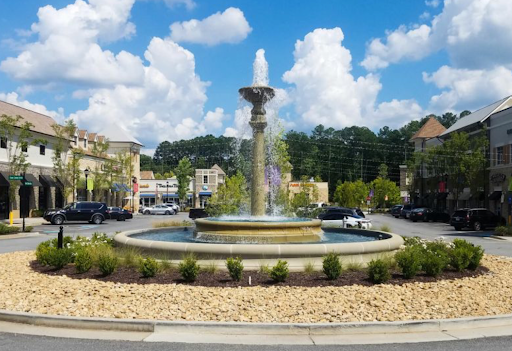
A fountain chosen for its visual impact alone can still end up in the wrong place, with the wrong jet, producing a sound that works against the acoustic goal it was meant to solve. Roman Fountains works with landscape architects during design to match flow rate, nozzle selection, and placement to the noise conditions of the actual site, not a generic spec sheet. Contact our design team to review the acoustic profile of your next project, or see it in practice at The Battery Atlanta, where fountains help anchor a busy mixed-use plaza.
Quick Answers
Do fountains actually reduce noise levels?
Not in the way a noise meter would show it. Fountains change what a listener notices more than they change the decibel reading, shifting attention from traffic and mechanical noise toward a softer, more natural sound.
What kind of fountain sound works best for masking traffic noise?
Broadband water sound with strong low-frequency content, like a full cascade or basin, tends to mask road traffic more effectively than a thin, high-pitched spray, because that’s closer to where traffic noise sits acoustically.
Can a fountain make a space sound louder instead of quieter?
Yes. Harsh, crashing water sound rated poorly in soundscape studies can lower a space’s perceived quality instead of improving it. Flow rate and jet selection determine which outcome a fountain produces.
Where should a fountain be placed for the best acoustic effect?
Between the listener and the noise source, close enough that the water sound reaches the ear first. Placement decided on sightlines alone, without the noise source in mind, gives up most of the acoustic benefit.