
Do Water Features Need A Constant Water Supply?
A common question for anyone considering a new water feature is about its water needs. The image of a constantly flowing stream might make you think you need a permanent connection to a water main, leading to a high utility bill. So, do water features need a water supply? The good news is that most standard water features do not need a constant supply of fresh water from your tap.
Instead, they operate as a closed-loop system, recycling the same water again and again. However, understanding how this works and why you still need to add water occasionally is key to enjoying a trouble-free fountain, pond, or waterfall. Managing your water feature supply is less about constant input and more about smart recirculation and managing natural loss.
The Recirculating Principle: The Engine of Your Water Feature
Virtually all self-contained garden water features and fountains are designed as recirculating systems. This is a simple but brilliant concept that makes these installations both practical and sustainable. At the core of this system is a pump, typically submerged in a reservoir or the base of the feature. Think of the reservoir as the heart of the operation and the pump as the muscle that keeps the blood – or in this case, water – flowing.
Here is a step-by-step look at how this closed-loop system functions:
- The pump, sitting at the lowest point in the reservoir, draws water in through an intake screen.
- It then pushes this water under pressure through a pipe or flexible tubing that leads to the feature’s outlet.
- The water is discharged at a high point, whether through a spout, over a waterfall weir, or out of a decorative fountain nozzle.
- Driven by gravity, the water then flows, falls, or trickles back down into the reservoir below.
- The cycle repeats itself indefinitely, creating the continuous movement you see and hear.
This means that after the initial fill, the same body of water is used over and over. The pump’s job is to move water, not to consume it. This elegant and efficient design is what makes water features practical for homes, parks, and public spaces everywhere.
The key to a successful and reliable system is selecting fountain pumps that are powerful enough to move the required volume of water for your specific design, guaranteeing efficient and consistent circulation without overworking the unit.
The Different Types of Water Features and Their Supply Needs
While the recirculating principle is universal, how it is applied can vary based on the type of feature. Understanding these differences helps clarify the water feature supply needs for your specific project.
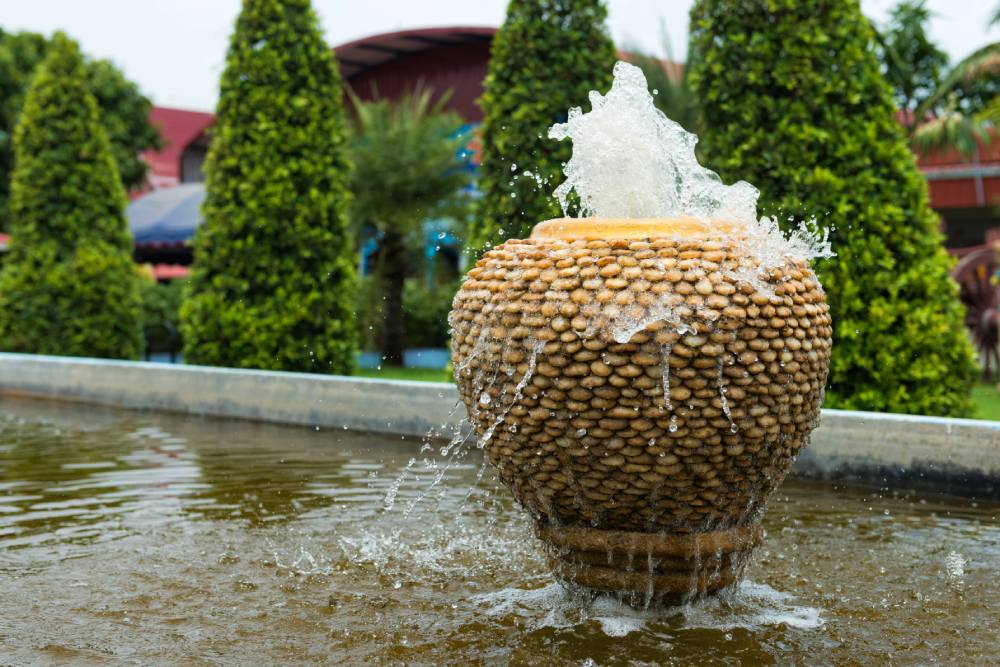
Bowl or Standalone Fountains: These are the simplest systems. They are a single, self-contained unit where the pump sits in a base that also acts as the reservoir. Water is pumped to the top tier and cascades back down into the base. Their water supply needs are minimal, typically requiring a quick top-off with a watering can or hose every few days to compensate for splash and evaporation.
Pondless Waterfalls and Streams: This popular design is all about illusion. A hidden reservoir, often a large, dug-out hole lined with a rigid tank or pond liner, is buried underground. The pump sits in this reservoir, pushing water to the beginning of a stream or the top of a waterfall. The water then flows downstream, disappearing over rocks at the end and trickling down through a layer of gravel back into the hidden reservoir. These systems are very efficient but may need more frequent topping off in summer due to the large surface area of the flowing water, which increases evaporation.
Ponds with Waterfalls or Fountains: These are combined ecosystems and water features. The pond itself acts as the large reservoir. A pump, often housed in a protective skimmer box, draws water from the pond and sends it to a waterfall filter or a fountain head. The water then returns to the pond, completing the loop. These systems benefit greatly from healthy aquatic plants that offer shade and help manage water quality naturally. Their larger volume means they lose water more slowly to evaporation, but they are not immune to it.
Large Commercial Installations: For major civic fountains or large architectural water features, the principles are the same, but the engineering is on a grander scale. These systems often use multiple, heavy-duty pumps in massive underground vaults or equipment rooms. While they recirculate thousands of gallons of water, their sheer size and the need for absolute reliability often make an automatic water supply system a necessary component, not just a convenience.
Why You Still Lose Water: The Three Factors of Natural Loss
Even though the system is a closed loop, it is not a perfectly sealed environment. You will inevitably need to add water to your feature from time to time to replace what is lost. This does not mean there is a fault with the recirculating principle; it is simply a fact of physics and the outdoor environment. There are three primary ways a water feature loses water.
Evaporation is the most significant factor. Water naturally turns from a liquid to a vapor, especially on the surface of the feature where it is exposed to air and movement. This process is greatly accelerated by direct sunlight, wind, and high temperatures. On a hot, windy day, you might be surprised by how much the water level can drop in just a few hours. A larger surface area, like that of a pond or a wide stream, will experience more total evaporation than a narrow, tiered fountain.
Splash and Drift is another common cause, particularly for features with high-energy displays. Depending on the design, especially with powerful fountain jets or waterfalls crashing onto rocks, a fine mist or occasional large splash can land outside the reservoir basin. A strong breeze can also carry this mist several feet away, where it lands on plants or pavement and does not return to the system. While usually a small amount compared to evaporation, over a week it can add up to a noticeable drop in water level.
Slow Leaks are a maintenance issue rather than a natural one. All mechanical connections, such as pipe joints, the pump housing, or the pond liner itself, have the potential to develop slow leaks over time due to wear, weather, or accidental damage. A small, persistent leak can slowly drain the reservoir. It is important to periodically check the system for any signs of dripping or consistently wet areas in the surrounding landscape that should be dry. If you find yourself adding water far more often than usual, a leak is a likely culprit.
When an Automatic Water Supply Becomes a Practical Necessity
For some residential garden features, manually topping off the water with a garden hose every week or so is perfectly manageable. However, there are many commercial and residential features where installing an automatic water supply, often called an auto-fill valve or float valve, shifts from a luxury to a practical necessity.
Large Commercial or Public Features are prime candidates. A massive civic fountain or a long, elaborate waterfall holds a vast amount of water. Manually filling it with a hose would be incredibly time-consuming, inefficient, and costly in terms of labor. An auto-fill system, tied to a building’s main water line, makes sure the water level is always perfect and the pump is always safe, without any constant manual oversight.
Very Hot and Dry Climates present a unique challenge. In these regions, the rate of evaporation can be so high that manual topping off would be a daily, or even twice-daily, chore. An auto-fill valve removes this burden, making sure the pump never runs the risk of operating dry and burning out, while also guaranteeing the feature looks its best even during extended heatwaves and droughts.
Features Requiring a Stable Water Level for operational or aesthetic reasons also benefit from a constant supply. For instance, a feature with a perfectly level skimmer edge—where the water is drawn into the filter—requires a very consistent level to function correctly. Similarly, a formal reflecting pool or a basin where even a slight drop in water level would expose an unsightly black liner demands precise level control. A float valve, similar to the one in a toilet tank, automatically opens a water line when the level drops slightly and shuts it off when the desired level is reached, maintaining perfect visual harmony.
It is important to note that while Roman Fountains offers the specialized equipment and engineering for the world’s most impressive water features, the principles of water management start with a solid understanding of recirculation and loss.
Our expertise lies in designing systems where every component, from the pump to the piping, works in harmony to minimize issues and ensure long-term reliability, for a small garden piece or a vast civic installation. Proper planning at the design stage can determine the most efficient and effective water feature supply strategy for any project.
Balancing Water Quality in a Recirculating System
Since the same water is constantly being recycled, its quality must be actively managed. Stagnant, untreated water in a sunlit environment can quickly become a breeding ground for string algae and single-celled algae (which causes green water), leading to clogged pumps and an unsightly appearance.
The movement created by the pump itself helps to oxygenate the water, which discourages some types of algae and is beneficial for any fish. However, for most features, especially ponds and larger streams, additional filtration is used. A filter, which can be a separate unit or part of a waterfall box, serves two purposes: it physically traps floating debris like leaves and dust, and it offers a massive surface area for beneficial bacteria to colonize.
These bacteria are the true workhorses of a healthy water feature, as they naturally break down harmful ammonia from fish waste and other organic matter into less harmful nitrates, keeping the water clear and healthy.
In some cases, especially in sunny locations where green water is a persistent problem, a UV clarifier can be a valuable tool. This device is plumbed into the system after the pump. As water passes by an ultraviolet light bulb inside a quartz sleeve, the UV radiation kills free-floating algae cells.
This prevents them from reproducing and turns the water crystal clear. It is important to remember that a UV clarifier does not replace a biological filter; it works in tandem with it. For the health of fish and plants, maintaining this balanced ecosystem is the most sustainable approach to water quality management.
Making the Right Choice for Your Feature and Lifestyle
So, does your water feature need a constant supply of new water? For the vast majority, the answer is no. A well-sized recirculating pump system is all you need, with the understanding that you will periodically add water to account for natural loss. This approach is simple, cost-effective, and efficient.
At Roman Fountains, we recommend investing in an automatic water supply system to ensure consistent water level for visual or functional reasons, to protect pumps and equipment, and to give peace of mind. The initial setup for an auto-fill system is more complex, as it involves running a protected, frost-proof permanent water line, but it offers unparalleled convenience and protection for your investment.