
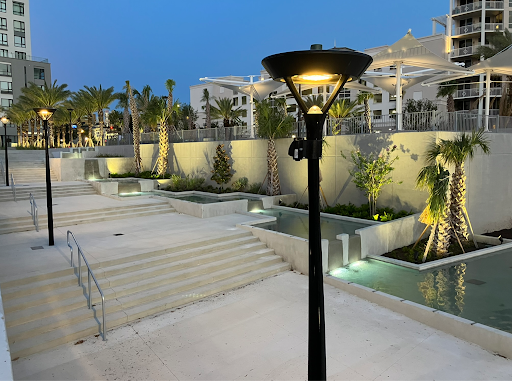
Designing Fountains for Drought-Conscious Landscapes
Short answer: a well-specified fountain uses a fraction of the water people assume, and in many water-restricted regions it can be designed to use less than the turf it replaces.
In water-restricted regions, a fountain is often the first line item a review board questions, sometimes before anyone checks how much water it consumes. The assumption is straightforward: drought conditions and water features don’t belong in the same master plan. That assumption is usually wrong, and it’s costing landscape architects a design tool that, specified correctly, supports the same sustainability goals the client is asking for everywhere else on the site.
The real issue isn’t whether a fountain belongs in a drought-conscious landscape. It’s whether it was designed for one.
Why This Objection Keeps Coming Up
Most water-use concerns trace back to a handful of legacy assumptions: that fountains run on a constant supply of fresh water, that evaporation losses are substantial, or that a water feature and a xeriscape plan are working against each other. None of that describes a properly engineered recirculating system, and the confusion tends to come from comparing a modern architectural fountain to a garden hose left running or an old, unfiltered decorative pool.
A fountain built on a closed-loop recirculating system reuses the same water continuously. The only water it loses on an ongoing basis is what evaporates off the exposed surface and whatever splashes out during normal operation. On a correctly sized system, that loss is measured in inches per week, not gallons per day, and it’s frequently lower than what an equivalent square footage of turf requires to stay green through the same stretch of weather.
Once that distinction is on the table, the conversation shifts from “should we cut the fountain” to “how do we specify it so the water use holds up under review.”
The Design Decisions That Determine Water Use
Water consumption in a fountain isn’t fixed by the fact that it’s a fountain. It’s set by a series of specification choices made well before construction, the same way maintenance load is.
Surface area and exposure. Evaporation scales with exposed water surface, not with visual drama. A tall, narrow jet loses less water to evaporation than a wide, shallow pool, even when the pool looks calmer. Wind exposure and direct sun both increase evaporation rate, so orientation and surrounding structure matter at the design stage.
Nozzle selection. Low-evaporation nozzles keep water in larger droplets and closer to the basin, reducing the amount that drifts off as mist before it can recirculate. Choreographed jet patterns can be built around these nozzles without sacrificing the visual effect a client is paying for.
Pondless and disappearing designs. A pondless waterfall or a disappearing fountain, where water discharges from a hidden basin below grade rather than sitting in an open pool, eliminates most of the standing surface area that drives evaporation. These designs read as a stream, a cascade, or a bubbling feature rather than a static pool, and they tend to fit naturally into a xeriscape plan rather than competing visually with it.
Basin sizing and turnover rate. An oversized basin holding more water than the feature needs increases both the standing volume at risk of evaporation and the load on filtration. Right-sizing the basin to the flow rate keeps both in check.
Automated shutoff and scheduling. Programmable controls can reduce jet height or shut a feature down during peak heat and wind hours, when evaporation rates spike, then resume full display during the hours people are there to see it.
Alternative water sources. Harvested rainwater and, where local code allows, treated non-potable or greywater can supply a fountain’s makeup water instead of drawing from the potable system. This is one of the more direct ways to move a water feature line item out of the conversation about a site’s water budget entirely.
Pairing With the Rest of the Site
A fountain doesn’t have to compete with the drought-tolerant planting plan around it. It works with it. A water feature surrounded by native grasses, succulents, or gravel and boulder accents reads as a considered contrast rather than an inconsistency, and it gives the planting plan a focal point instead of leaving it to carry the whole design on its own. This is also where a fountain earns its place in a stormwater strategy: tying a feature into a Sustainable Urban Drainage System or a rain garden lets it filter and reuse runoff that would otherwise leave the site, turning a water feature into part of the water management plan rather than a separate demand on it.
None of this requires abandoning scale or ambition. Sandy Springs City Center and Columbus Circle both demonstrate that a fountain can anchor a significant public space without becoming the reason a project fails a water-use review, provided the specification accounted for it from the start.
Making the Case to a Water-Conscious Client or Review Board
The strongest argument here isn’t aesthetic. It’s a specific comparison: the fountain’s estimated weekly water loss against the water demand of whatever would otherwise occupy that square footage, whether that’s turf, a decorative pool without recirculation, or an unshaded hardscape that does nothing for the site’s cooling load. In most water-restricted regions, a properly specified fountain compares favorably, and having that number ready before the question is asked changes the tenor of the entire budget conversation.
The equipment specification, filtration sizing, and water-source plan need to be locked in before construction, not adjusted afterward. A feature that gets value-engineered on the water side after the drawings are approved is where drought-region fountains run into trouble, and it’s avoidable with the right partner at the design stage.
Design It to Hold Up Under Review
A fountain built for a drought-conscious region needs the same engineering discipline as one built for anywhere else, applied to a different set of constraints. Roman Fountains works with landscape architects to specify recirculating systems, low-evaporation nozzles, and alternative water sourcing that hold up against a water-restricted site’s requirements before the design goes to review. Contact our design team to size a water-conscious fountain for your next project, or see how it plays out in projects like Sandy Springs City Center and Powder Springs Park.
Quick Answers
Do fountains use a lot of water in drought regions?
No, not when they’re built on a closed-loop recirculating system. Ongoing water use comes almost entirely from evaporation and splash-out, typically a few inches per week, which is often less than the water demand of an equivalent area of turf.
Can a fountain fit into a xeriscape or drought-tolerant landscape plan?
Yes. Pondless and disappearing fountain designs pair naturally with native and drought-tolerant plantings, and tying a feature into a rain garden or stormwater system lets it reuse runoff instead of adding to site water demand.
What design choices reduce a fountain’s water use the most?
Low-evaporation nozzles, right-sized basins, pondless or disappearing designs, and automated scheduling that reduces output during peak heat and wind all meaningfully cut water loss. Alternative water sourcing, like harvested rainwater, can reduce it further.
Will a fountain survive a water-use review in a drought-restricted region?
It can, provided the water-use numbers are calculated and documented at the design stage rather than estimated after the fact. Projects that run into trouble usually skipped this step, not because the fountain itself was the problem.