
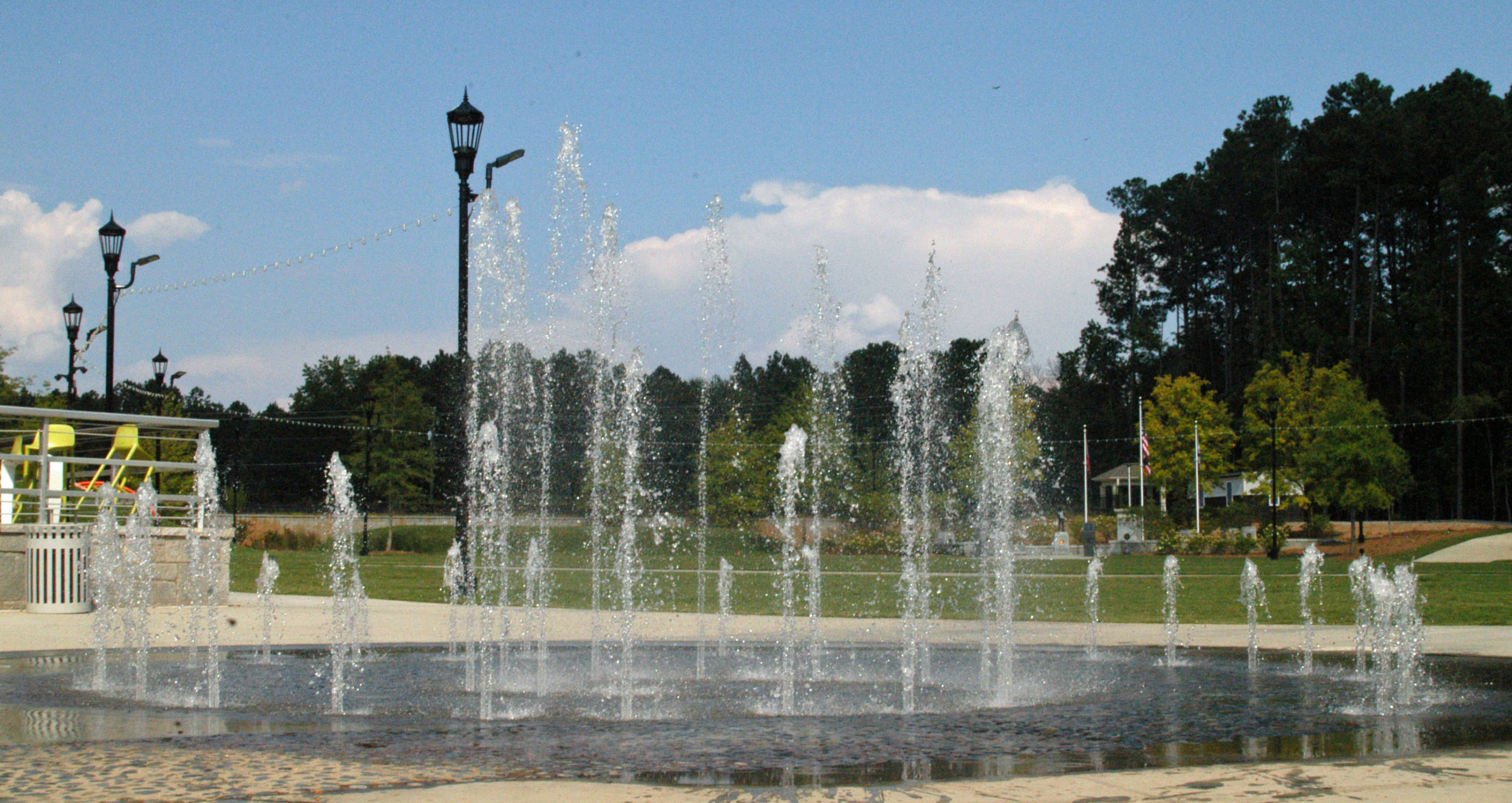
Splash Pad vs. Fountain: Which Fits Your Public Park?
The two get lumped together in early planning conversations because they’re both “water features” on a site plan. In practice, they solve completely different design problems, carry distinct cost and maintenance profiles, and answer to different regulatory codes. Getting the distinction right before the schematic design phase avoids expensive rework, unexpected budget spikes, or code compliance issues later on.
Splash Pad and Fountain: Defined
- Splash Pad: A zero-depth, interactive water feature built directly into a hard or resilient surface. Water sprays up through deck-mounted nozzles or drops from overhead features, then drains away immediately rather than collecting in a standing pool. Because there is no standing water depth, no lifeguard is typically required, which makes them attractive to municipal recreation departments.
- Fountain: A water feature built around a basin, pool, or reflecting surface where water recirculates continuously through a contained reservoir. It can range from a tranquil reflecting pool to a choreographed, multi-jet architectural display.
That single structural difference, standing water versus zero-depth drainage, drives almost every operational difference between the two.
Splash Pad vs. Fountain: Side-by-Side Comparison
| Feature / Factor | Splash Pad (Interactive Play) | Fountain (Architectural / Decorative) |
| Primary Purpose | Active, interactive recreational play | Visual anchor, placemaking, ambient atmosphere |
| Standing Water | None (zero-depth; immediate deck drainage) | Yes (contained basin, pool, or reflecting reservoir) |
| User Interaction | Direct, high-contact, hands-on immersion | Visual or ambient (occasional perimeter wading) |
| Water Usage (Per Hour) | Higher (constant active spray volume) | Lower (closed-loop recirculating volume) |
| Health Code & Oversight | High (Regulated as recreational water contact) | Moderate (Varies based on public access/wading) |
| Typical Park Placement | Playgrounds, family zones, splash zones | Plaza entries, courtyards, civic centers, monuments |
| Noise Profile | High (splashing, laughing, active play sounds) | Adjustable (silent reflection to dramatic waterfalls) |
| Maintenance Frequency | High (Daily/weekly water quality & chemical checks) | Moderate (Standard filtration & seasonal maintenance) |
| Best Suited For | Recreation departments, active family destinations | Landscape architects, civic identity, landmark sites |
Where Each Water Feature Wins
Splash Pads Win on Activation
A splash pad is one of the most reliable ways to turn an underused park corner into the busiest destination on the site. Interactive play draws families back repeatedly. Unlike fixed playground structures, the experience can change dynamically through programmable sequencing, timed water bursts, and seasonal variations.
Fountains Win on Identity and Versatility
A fountain does more heavy lifting per square foot from an architectural standpoint. It anchors sightlines, marks main entryways, and gives a quiet plaza a reason to exist without needing constant foot traffic to justify its presence. A reflecting pool performs its aesthetic job just as effectively at 2 a.m. as it does at noon.
Design Tip: The two aren’t mutually exclusive. A master plan specifying a splash pad for a family zone and a decorative fountain for the main entry plaza solves two unique design challenges without redundant spending.
Cost and Maintenance: Compared Honestly
- Operating Costs: Splash pads often cost more to operate on a per-hour basis because water is in continuous motion. Furthermore, health departments in many jurisdictions regulate splash pads under strict recreational water rules, requiring mandatory UV/ozone treatment systems, backflow prevention, and routine chemical testing.
- Fountain Upkeep: Fountains run on standard recirculating filtration systems. Typical maintenance includes weekly visual checks, monthly filtration/water chemistry reviews, and an annual deep service. Because water isn’t in direct, high-contact human use, regulatory overhead is usually lower.
Neither option is low-maintenance by accident. Both depend on filtration systems sized correctly during the initial design phase.
Safety and Local Code Considerations
Regulatory requirements will frequently dictate your choice long before aesthetic preference enters the conversation:
- Splash Pad Rules:Splash pads are designed for direct human contact, which puts them under strict health and safety codes, frequently the same framework that governs public pools.
- Fountain Rules: Fountains designed strictly as visual elements (e.g., a reflecting pool behind a low barrier) enjoy lighter regulatory burdens. However, if a fountain features wadeable edges or shallow basins accessible to the public, inspectors may classify it as an interactive feature.
Confirming classification with your local health authority early in the schematic phase prevents expensive regulatory surprises later.
How to Decide for Your Site
Ask these key questions to settle the decision quickly:
- Is the primary goal interaction or ambiance? Choose a splash pad for active play; choose a fountain for landmark appeal or quiet relaxation.
- What is the site’s foot traffic pattern? Playgrounds and family zones demand splash pads. Entry plazas, courtyards, and memorial zones favor fountains.
- What does the ongoing operational budget support? Splash pads require more rigorous daily water quality management. Fountains offer more flexibility to scale both design complexity and long-term costs up or down.
- Does the site call for both? Projects like Powder Springs Park successfully pair an interactive splash area for families with an elevated fountain feature that anchors civic identity.
Specify the Right Feature the First Time
Choosing between a splash pad and a fountain comes down to how you intend visitors to interact with your space. Roman Fountains collaborates directly with landscape architects, municipal planners, and recreation departments to engineer water features that balance aesthetic intent, public safety, and long-term operational budget.
Ready to start your site design? Contact our design team today to review your park’s water feature program or explore our project gallery for inspiration.
Frequently Asked Questions
Is a splash pad cheaper than a fountain?
Not necessarily. While the initial hardscape of a splash pad may appear simpler than a fountain basin, splash pads often carry higher operational costs due to continuous water volume treatment, advanced filtration demands, and strict health code monitoring.
Do splash pads need a lifeguard?
Typically no. Because splash pads are engineered as zero-depth surfaces with immediate deck drainage, standing water hazards are eliminated, making lifeguards unnecessary under most municipal codes.
Can a public park feature both a splash pad and a fountain?
Yes. Many comprehensive park master plans utilize both: positioning interactive splash pads in high-energy family zones while placing decorative fountains at entrances or civic gathering plazas on the same property.
Which requires more maintenance: a splash pad or a fountain?
Splash pads generally demand more frequent maintenance due to direct, high-contact human interaction and stringent health department standards for chemical and UV disinfection. Fountains typically follow standard recirculating filtration and monthly chemical checks.