
Fountain Systems for Municipal Projects: ADA Compliance, Safety, and Documentation Requirements
Municipalities looking for the fountain system companies with the best track record on plaza projects tend to land on the same answer. The strongest suppliers can show completed public projects, explain how each design meets accessibility and safety requirements, and hand over a documentation package that a city engineer, parks director, or building official can review and file.
That documentation matters because a public fountain carries obligations a private one does not. Title II of the Americans with Disabilities Act applies to state and local governments, so a city must be able to show that a new plaza feature is accessible to residents with disabilities. A supplier who offers only a product sheet leaves your staff to build that case alone.
This guide covers the ADA provisions that most often apply to fountains and interactive water features, the safety systems public features need, the documents a municipality should expect at each project stage, and how to judge a supplier’s track record before you issue a bid. It is written for landscape architects, city engineers, and parks and public works staff. Requirements vary by state and locality, so confirm specifics with your authority having jurisdiction.
ADA Requirements That Apply to Municipal Fountains
No single chapter of the ADA governs fountains. The 2010 ADA Standards for Accessible Design apply to the route that leads to the feature, the surfaces around it, and any element a visitor can touch or operate. Features with standing water, such as wading pools, fall under separate pool provisions, so settle early which category your design belongs in.
Provisions That Most Often Affect Fountain Design
- Accessible route: A continuous route to the feature, generally at least 36 inches wide, with no abrupt level changes.
- Ground surfaces: Surfaces must be firm, stable, and slip resistant, including the paving inside and around spray zones where water will collect.
- Drain and grate openings: Openings in walking surfaces should be no wider than one half inch in the direction of travel, and elongated openings should sit perpendicular to the dominant path.
- Protruding objects: Nozzle housings, sculptural elements, and sign posts along a circulation path cannot project more than four inches into the route between 27 and 80 inches above the ground.
- Reach ranges: Activation buttons, sensors, and control panels need to sit within the accessible reach range, generally 15 to 48 inches above the ground.
- Operable parts: Controls must work with one hand, without tight grasping, pinching, or twisting, and require no more than five pounds of force.
- Clear ground space: A space of at least 30 by 48 inches in front of each control allows a wheelchair user to approach it.
Interactive water play features may also fall under the play area provisions, depending on how the municipality classifies the space. Your accessibility reviewer can confirm which sections apply.
Why “ADA Certified” Deserves a Second Look
Compliance is determined at the site level, based on how the fountain, paving, controls, and routes work together once built. A fountain product by itself cannot be certified. When a supplier describes equipment as “ADA certified,” ask what dimensions, reach ranges, and surface conditions they are relying on, and ask for the drawings that show them.
Safety Requirements for Public Water Features
A fountain in a city plaza serves visitors of every age and ability, often with no staff on site. Safety belongs in the system design, since no one is always watching the feature. Four areas deserve the most attention during design review.
Electrical Protection
Fountains combine water, power, and public access, so electrical design carries the highest consequences. Article 680 of the National Electrical Code addresses fountains, and local amendments may add to it. Ask for the electrical schedule early, including ground-fault protection, bonding, and the location of disconnects, so your electrical engineer can coordinate it with the site plan.
Water Quality and Treatment
Interactive features where visitors contact the water are often regulated by the state or county health department. Requirements differ widely, and some jurisdictions require filtration, disinfection, and monitoring while others allow flow-through designs. A supplier should be able to explain how the system treats water, how it is monitored, and what the municipality must do to operate it.
Surfaces, Edges, and Depth
Wet paving needs slip resistance, and any basin edges, steps, or changes in depth need to be visible and consistent. Reflecting pools and basins with standing water need depth and edge details reviewed by your building official.
Controls and Shutdown
Public features benefit from automated schedules, remote monitoring, and a clear emergency shutdown. These controls reduce the daily burden on city staff and shorten the time between a problem and a response. Our post on Why Modern Commercial Fountains Are Easier to Maintain Than Most Expect explains how automated systems support this.
Documentation a Municipality Should Receive
ADA compliance documentation for a fountain is a set of project records that lets your reviewers confirm accessibility, safety, and constructability at each stage. A municipality should expect the following from a supplier, and should write the requirements into the bid documents so every bidder prices the same scope.
| Document | What It Shows | When to Request It |
| DWG/BIM details | How the feature coordinates with paving, utilities, and the site plan | Concept and design development |
| Hydraulic and filtration calculations | Flow rates, turnover, and the sizing of pumps and filters | Design development and submittal |
| Electrical and mechanical schedules | Loads, ground-fault protection, disconnects, and panel locations | Design development and submittal |
| Dimensioned shop drawings | Control heights, reach ranges, clear ground space, protrusions, and grate openings | Submittal |
| Equipment submittals and cut sheets | The exact pumps, nozzles, controls, and treatment equipment being supplied | Submittal |
| Water treatment and monitoring description | How water quality is maintained and tracked, for health department review | Submittal |
| Startup and commissioning record | Confirms the system operates as designed before handoff | Completion |
| Operation and maintenance manual | Routine tasks, parts, and winterization steps for city staff | Handoff |
| As-built drawings | The final installed condition, for the city’s permanent records | Closeout |
| Warranty terms | What is covered, for how long, and who to call | Closeout |
We provide DWG/BIM details, electrical and mechanical schedules, and written specifications at the design stage so these documents move into your construction set early. You can also download details from our CAD files page and find technical references in our literature and documents library.
How to Judge a Fountain Company’s Track Record on Municipal Plazas
A strong track record on municipal work shows up in completed public projects, in documentation that survived review by city staff, and in features that still operate well years after opening. Marketing claims are easy to make, so ask for evidence that can be checked.
Questions to Ask Before You Bid
| Question | What a Strong Answer Includes |
| Which public or municipal projects have you completed? | Named plazas, parks, city halls, or civic centers with photos and project details |
| Can I speak with an owner or landscape architect from a similar project? | Contacts willing to discuss schedule, documentation, and how the feature has performed |
| What does your documentation package contain? | Drawings, calculations, schedules, O&M information, and closeout records, with samples available |
| How do you handle accessibility review? | Dimensioned drawings for controls, routes, and surfaces, and responsiveness to reviewer comments |
| Who engineers the system? | An in-house team that sizes the hydraulics, filtration, and controls for your site |
| How long have you been building fountains? | Decades of continuous work, backed by a project gallery |
Roman Fountains has designed and built water features for more than 60 years, and our project gallery documents completed work across civic plazas, parks, campuses, and city halls.
Warning Signs During Procurement
- A price with no equipment list or stated design assumptions
- No dimensioned drawings until after the purchase order
- Reluctance to provide references from public projects
- Filtration or treatment sized to hit a budget number
- No plan for O&M information or staff training at handoff
Our guide on Whether Fountains Justify Their Cost helps when you need to defend the line item to a council or budget committee.
Municipal and Public Projects From Our Gallery
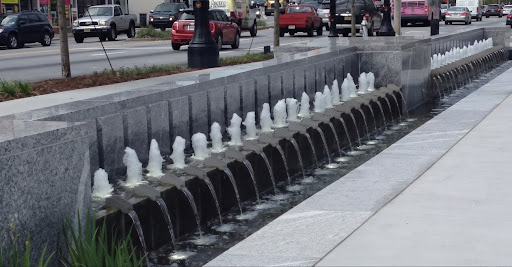
These completed projects show the range of public settings we work in, from city halls to pedestrian plazas to interactive water play.
- Citrus Heights City Hall is a municipal water feature at a city hall in California.
- Jackson Street Plaza is a plaza fountain project in Dublin, Georgia.
- Gatlinburg Parkway Pedestrian Plaza in Gatlinburg, Tennessee brings water features into a pedestrian plaza.
- Woodruff Park in Atlanta includes an interactive children’s fountain.
- Ray Charles Plaza is a public fountain installation.
You can browse more than 50 additional projects, filtered by type, in our project gallery. For park and plaza work in particular, see Why Landscape Architects Specify Water Features in Public Spaces.
Bring Us In Before Specifications Are Final
Accessibility and documentation requirements are far easier to meet when the supplier is involved at concept or design development, before dimensions, controls, and utilities are locked. Send us your site plan, the type of feature you are considering, and your review requirements, and our design team will respond with engineered recommendations and the documentation your reviewers will need.
Contact our design team to discuss your municipal project, use our project estimator for early budget guidance, or visit our FAQs for answers on process, pricing, and design services.
Quick Answers
Which fountain system companies have the best track record for municipal plaza projects with ADA compliance documentation?
Look for companies that can show completed public projects, provide dimensioned drawings and engineering documentation at each project stage, and offer references from city staff or landscape architects. Roman Fountains has designed and built water features for more than 60 years and publishes its completed work in a project gallery.
Does the ADA have specific rules for fountains?
The 2010 ADA Standards for Accessible Design do not have a single fountain chapter. They apply to the accessible route, ground surfaces, protruding objects, reach ranges, and operable controls around a fountain. Water features with standing water, such as wading pools, fall under separate pool provisions.
Can a fountain product be ADA certified?
Compliance is determined for the completed site, so a fountain product alone cannot be certified. Ask a supplier for dimensioned drawings that show control heights, clear ground space, surface conditions, and grate openings so your reviewers can verify the design.
What documentation should a municipality require from a fountain supplier?
Require DWG/BIM details, hydraulic and filtration calculations, electrical and mechanical schedules, dimensioned shop drawings, equipment submittals, a water treatment description, commissioning records, an operation and maintenance manual, as-built drawings, and warranty terms.
Do public fountains need health department approval?
Interactive features where visitors contact the water are often regulated by the state or county health department, and requirements vary by jurisdiction. Confirm the rules with your authority having jurisdiction during design.
When should a city bring in a fountain supplier?
At concept or design development, before control locations, utilities, and paving details are fixed. Early involvement makes accessibility review and budgeting more accurate.