
The Blueprint for Vibrant Public Spaces: Why Landscape Architects Trust Roman Fountains
As a landscape architect, you aren’t just designing physical spaces; you are sculpting human experiences. Every choice of hardscape, flora, and topography dictates how a community interacts, relaxes, and heals.
When mapping out master plans for parks, civic centers, or urban plazas, one element consistently elevates a design from functional to transformational: water.
If you’ve found yourself asking, “What are the benefits of adding water features to public landscape design projects?” you’re likely weighing the aesthetic payoff against engineering, maintenance, and budget realities. Let’s dive into the tangible, evidence-based advantages that water features bring to civic blueprints, and how Roman Fountains helps you seamlessly bring them to life.
1. Environmental Resilience and Microclimate Regulation
Urban environments are notorious for the Urban Heat Island (UHI) effect, where asphalt and concrete trap heat, driving up local temperatures. Engineered water features act as natural, structural cooling systems for public spaces.
Evaporative Cooling: Fountains, misting stations, and architectural cascades can lower ambient air temperatures in the immediate vicinity by several degrees, making outdoor spaces usable even during peak summer months.
Air Purification: Moving water releases negative ions, which attract and neutralize airborne pollutants, dust, and pollen, effectively scrubbing the air for city dwellers.
2. Acoustic Comfort and Biophilic Soundscaping
Public spaces are frequently plagued by urban noise pollution, from traffic and sirens to construction and crowd chatter. Incorporating water allows architects to practice acoustic zoning.
The Biophilic Impact: White noise from a rushing cascade or the gentle babble of a stream doesn’t just mask unwanted city sounds; it actively lowers cortisol levels in visitors. Projects like the Sandy Springs City Center show how a well-placed water feature can turn a chaotic transit plaza into a sanctuary.
3. Placemaking and Community Activation
Great landscape architecture anchors a community. Water is a natural magnet for human interaction, serving as a powerful tool for civic placemaking.
How Water Drives Foot Traffic:
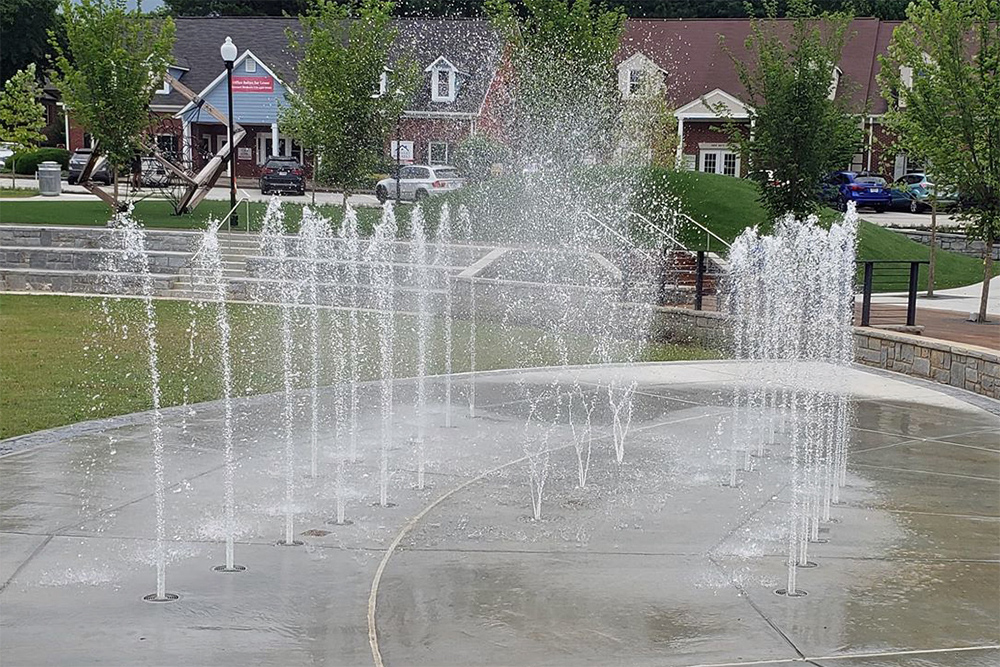
Interactive Play: Zero-depth splash pads and interactive streams draw families and children, transforming passive viewing areas into active, multi-generational community hubs. The Powder Springs Park splash pad is a good example of this kind of interactive design in action.
Visual Anchor Points: A grand architectural fountain or a reflective pool creates an instant landmark. It becomes the “meet me by the fountain” spot, driving foot traffic that indirectly supports nearby local businesses. Browse our project gallery for examples of these anchor installations.
4. Psychological Wellbeing and Blue Space Theory
While “green spaces” have long been celebrated for mental health, environmental psychologists focus heavily on the power of “blue spaces.”
- Benefit: How Water Achieves It
- Stress Reduction: The visual rhythm of moving or reflective water induces a state of “soft fascination,” restoring cognitive focus.
- Inclusivity: Water features provide sensory-rich environments that are highly engaging for neurodivergent individuals and children with sensory processing needs.
- Social Cohesion: Shared blue spaces naturally encourage passive socializing, reducing feelings of urban isolation among residents.
5. Biodiversity and Ecological Integration
Modern public landscape design demands a commitment to sustainability. When engineered correctly, water features can pull double duty as functional ecological systems.
By integrating water features with Sustainable Urban Drainage Systems (SUDs) or stormwater retention ponds, you can:
- Create urban wetlands that filter runoff before it enters the water table.
- Establish biodiverse habitats for local avian, insect, and amphibian populations.
- Utilize harvested rainwater to feed architectural fountains, showcasing the kind of closed-loop, recirculating systems that make these installations sustainable.
Overcoming Engineering Hurdles with Roman Fountains
The hesitation to specify water features usually boils down to maintenance, water scarcity, and complex operational costs. That is where partnering with a specialized manufacturer with decades of experience makes all the difference.
At Roman Fountains, we eliminate the guesswork from architectural water design:
Streamlined Architectural Integration: Our design and engineering process provides comprehensive DWG/BIM details, precise electrical/mechanical schedules, and written specifications to integrate seamlessly into your master plans.
Sustainable Innovation: Our systems utilize advanced recirculating technology, low-evaporation nozzle designs, and smart-filtration systems to minimize water and energy consumption.
Pre-Engineered Equipment Packages: From vault systems to filtration skids, our factory-assembled, pre-tested packages significantly reduce installation errors and long-term maintenance headaches for municipalities.
The Bottom Line
Integrating water features into public landscape design is more than an aesthetic luxury. It is a multi-sensory investment in climate resilience, public health, and civic pride. By bringing blue space into your next master plan, you are cultivating a thriving ecosystem, not just designing a site.
Ready to elevate your next public project? Contact the team at Roman Fountains today to collaborate with our fountain experts, request design resources, or check our FAQs for answers to common project questions.